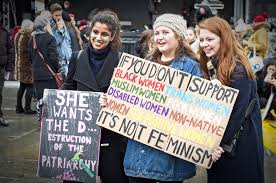
Long live feminism. You cruel mistress. Taunting and teasing about fair pay, representation, and fundamental change (what do any of those things actually mean anymore?). This is not an ode to feminism. This is a eulogy. But not a very reverent one.
I am sick to death of the words “Kamala is brat,” of corporate girl boss feminism—so palatable, so marketable. I think the drivel of what we call “Second Wave Feminism,” with all its meandering prose on sexuality and race, is mentally where a lot of us are still stuck. I feel like I am trapped in a brat green, Barbie pink, silk-lined coffin while Lena Dunham’s “Girls” is playing on repeat. I am trying to get unstuck.
Don’t get me wrong. I loved “Barbie.” I cried with everyone else in the theater that day and loved all of its cringe, feminism 101 type quips. I loved the lawlessness of “brat” and I loved that a woman of color was nominated by a major party to become the next President of the United States. But what these three cultural moments have in common is that distinct flavor and marketability of girl boss, liberal feminism, that specific brand of feminism supercharged by capitalism.
Everything I thought I knew about feminism has changed irrevocably over the past five years, in quick succession. The feminism of today is not quite the same flavor as the heady passion that fueled the Women’s March in 2017. Or even the feminism that lit the fire for the #MeToo movement.
The distinct flavor of feminism from the early 2010s, which I consumed greedily when I was 15, has drastically changed over the years. It has become a great disappointment. But maybe that’s all it was destined to become.
“Feminism,” has always been a contentious word as long as I have known it. Even at the height of #MeToo, when everyone was jumping into the conversation on glass ceilings, fair wages, and harmful gender tropes, I knew plenty of girls who were hesitant to identify as feminists and I could never fathom their hesitation (like what do you mean you don’t want to champion gender rights and equality???).
Institutionally and socially, feminism is dead.
We could start with the repeal of Roe v. Wade and other milestone lawsuits that were the cornerstone of women-led activism from the 1970s. When abortion rights were threatened in countries like Brazil, Benin, Cameroon, Guinea, and Côte d’Ivoire, women took to the streets and haven’t stopped organizing or protesting since. When Roe v. Wade was overturned in 2022, activists responded with protests—but without enough funding or constant protestors, they fizzled out.
The crumbling of the #MeToo Movement, diffused by controversies and accusations, saw the appeal of Harvey Weinstein’s case, to minimum repercussions. And lastly, the ease with which Kamala Harris’s campaign team latched onto the branding and optics associated with “brat”—without ever having to mention Harris’s gender—is a telling example of feminism’s dilution.
I’ve understood the deadening of feminism not necessarily as a total disavowal of rights but instead a rejection of the culture reproduced by feminism, a culture that isolates marketable aspects of womanhood and co-opts into capitalism.
A liberal ideology, like the liberal feminism examined here, is a sea of lone voices crying into an abyss. It’s the mounting wave of desperation that follows the detachment from all life around us and reduces us down to a world of one. It viciously leaches into our innermost dreamlands and tells us that we need for nothing else but to selfishly consume and contribute to the aggrandizement of our own ego. It, as a tool utilized by the powerful, elite classes, works to undo the actualization of liberatory movements; breaking apart communities and their attempts to emancipate themselves from the systems of violence directly imposed on them and the generations that preceded them, reducing the sum of a collective down to its base parts—the individual.
Audre Lorde, a Caribbean-American writer who identified as a Black, lesbian, mother, warrior, and poet, once stated (before a room of liberal feminists), “The master’s tools will never dismantle the master’s house.”
Her words have echoed over time without ever truly seeming to settle.
Lorde’s analysis attacks the limits of the liberal ideologies that have dominated the american political landscape since the early 20th century. Such ideologies reduce each attempt at a mass, interconnected feminist movement to the pages of a history book, and leave those who don’t fit the cultural narrative in the margins.
The force that our nation has utilized to oppress its people can not be the same force utilized to free them. Racism, sexism, homophobia won’t be voted out. Girlbosses in the boardroom or even the whitehouse won’t emancipate working class women and fem presenting people from the violent reaches of the capitalist patriarchy. That truth carries itself through generations and is crucial to hold close as we sit on the precipice of the first POC woman becoming head of state—while feminism lies cold in the grave.


 Immersed Zine
Leave a comment